
How to Write Feudalism in Fantasy the Right Way
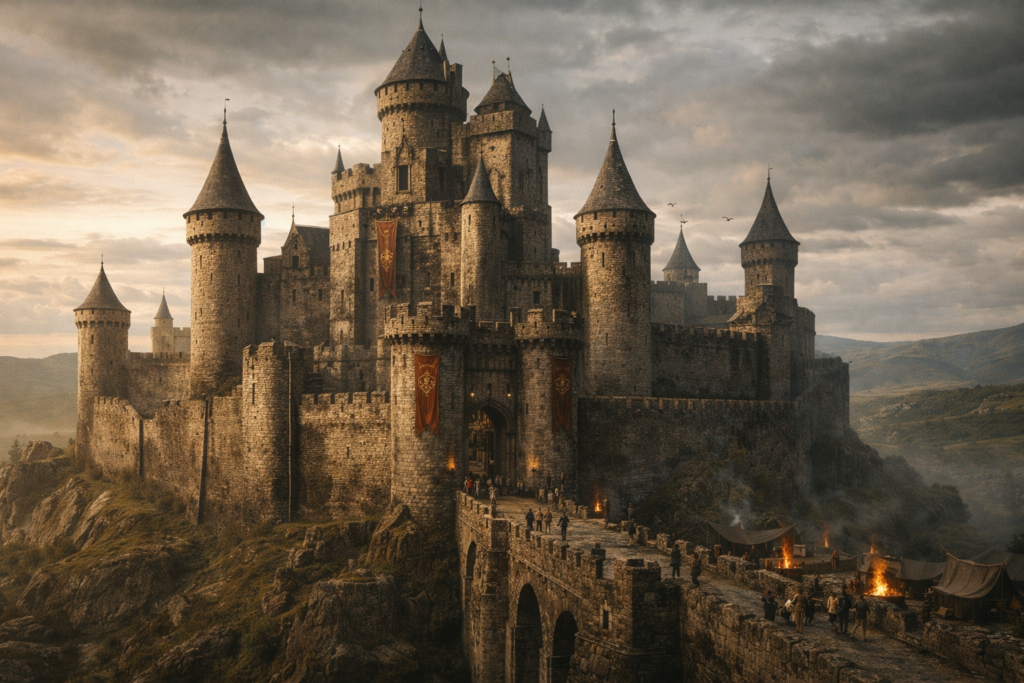
Table of Contents
Feudalism is one of the most commonly used political structures in fantasy. You’ve seen it everywhere: castles, knights, hereditary titles, sworn oaths, and kings sitting on thrones. It’s practically the backbone of the fantasy genre at this point. However, a lot of fantasy writers use feudalism more as a visual aesthetic than as a functioning system, and that’s where stories start to feel hollow. If you want your world to feel genuinely immersive and believable, you can’t just slap a king on a throne and call it a day. Feudalism is an economic system, a military structure, a legal hierarchy, and a social contract all wrapped into one. Once you understand that, your world building will get a whole lot stronger. So, for today’s post, I’ll be breaking down how to write feudalism in fantasy the right way.
I’ve been writing fantasy and sci-fi for a long time (check out my series, The Fallen Age Saga) and I talk a lot about world building on this blog because it’s one of the most essential things you can get right as a fantasy writer. If you’re just starting out, grab a free copy of my 10-question world building primer. It’ll help you get a basic idea of your world building direction before you dive into the deeper stuff.
Your World Building Journey Begins Here…
Get 10 powerful prompts that will spark a living, breathing world and set the stage for the epic details to come.
A Messenger Has Arrived…
They carry your 10-Question World Primer, sealed with my crest. Break the seal (open your inbox) to begin shaping your realm.
What Feudalism Actually Is
Before you start designing anything, it helps to understand what feudalism actually means at its core. Feudalism is a system built on land ownership and mutual obligation.
A monarch grants land to nobles. In exchange, those nobles provide military service, taxes, and loyalty. Beneath them are lesser lords, knights, and peasants who work the land and keep the whole thing running.
The key word here is obligation.
Feudal societies are not just about who has the most power. They are held together by promises, oaths, and expectations between every level of the hierarchy. When one layer fails or breaks that obligation, the entire structure starts to shake. That instability is where your best story conflicts are going to come from.
Feudalism can be best depicted in a sort of pyramid-like structure. It was used historically in Medieval Europe as well as Japan. The difference lies in the names of particular positions, such as Shoguns in Japan.
Land Is Equal to Power in Feudalism
In a feudal world, land determines wealth, influence, and survival. A noble without land is a noble in name only. A king who cannot reward loyalty with territory loses his grip on power fast. A peasant tied to poor soil suffers in ways that a peasant farming rich river valley land does not.
When you’re designing your setting, think carefully about how land is distributed and what it actually produces. Does your kingdom rely on grain, livestock, mining, or trade routes? Geography shapes hierarchy in ways that are easy to overlook but make a massive difference when it comes to how believable your world feels.
Castles, in real feudal systems, existed to defend something valuable. If your story’s castle is just there to look imposing, you’re missing an opportunity to make your world feel grounded.
A great example of a video game that depicts this system is Kingdom Come Deliverance, as it takes place in the modern-day Czech Republic back when it was medieval. You play as Henry, who sort of goes up in the ranks to become a knight and things like that. You deal often with noble lords, knights, peasants, merchants, etc… It’s a wonderful historical experience and it’s very accurate to the time.
Military Obligation Drives Conflict
Feudalism and warfare are completely inseparable. Nobles receive land with the expectation that they will provide soldiers when the crown calls for them. Knights swear loyalty to lords in exchange for protection and status. This creates a whole web of obligations that can snap at any point. Oftentimes, if you want to write a fantasy story with feudalism as the structure, you’ll probably focus a lot on knights, warfare, and the invovlement of nobility in the practice.
Think about what happens in your story if a lord refuses to answer the king’s call to war. What if a noble simply cannot afford to equip soldiers? What if rival lords are competing so hard for influence that they refuse to cooperate on a shared military campaign? Think of Game of Thrones here.
Check out this post to learn how to write a story like Game of Thrones!
Military obligation should not just be background flavor in your story. It should be a direct source of plot tension. Some of the best political conflicts in fantasy come from characters being pulled between their sworn duties and their own survival or ambitions.
This is why one of the biggest topics I focus on in The Ultimate Guide to World Building is the idea of militaries and forming them and working with them. It’s very important to the fantasy genre as a whole, because if your military doesn’t make sense logically, then that’ll show in your story.
Social Hierarchy Shapes Daily Life
Feudal systems divide society into clear ranks, but those ranks are not just decorative: they affect marriage, inheritance, justice, and opportunity at every level.
A peasant cannot simply travel freely without consequence. A noble marriage is rarely about love. Inheritance disputes can and historically did ignite civil wars. These are the kinds of details that make a feudal world feel real rather than like a backdrop.
Think about how your characters experience their rank. A stable hand, a minor knight, and a duke are going to interpret the same political event in completely different ways. Their fears and ambitions should reflect exactly where they sit in the system.
Religion and Feudal Authority
In many real feudal societies, religious institutions were deeply tied to political power. Kings ruled by divine right. Oaths were sworn in front of sacred authorities. Heresy could very quickly become treason.
If your world includes an organized religion, think carefully about how it reinforces or challenges feudal rule. Does your church crown monarchs? Does it own land and collect taxes? Does it compete with secular lords for influence?
When religion and feudalism intersect in your story, your political world gains so much more texture and depth. It also opens up incredible conflict. For example, a king who relies on religious legitimacy to rule is vulnerable the moment the church turns against him.
Religion is such a big part of world building that I often feel is overlooked in many fantasy books. Check out this post to learn more about how to create a fictional religion!
How to Write Feudalism in Fantasy: A Step-by-Step Guide and Framework
Here is a practical breakdown you can use to design a feudal system that actually feels complete rather than decorative for the sake of existing.
Step 1: Define the Monarch’s Authority
Start by figuring out how much real power your ruler actually has. Is the king absolute, or is he constantly managing a council of powerful nobles who could unseat him? The tension between central authority and regional power is one of the most fertile sources of conflict in feudal settings.
Check out this post here to learn how to create a royal family in your story.
Step 2: Map Out Land Distribution
Determine who controls which territories and why. Think about what each region produces and what makes it strategically valuable. Land distribution tells you a lot about who has real power in your world and who is vulnerable. Creating a map is a great way to start with figuring out how things are actually split across your kingdom.
Step 3: Establish Military Expectations
At this point, you’ll want to clarify what each noble owes the crown in times of war and what happens when they fail to deliver. This is where a lot of your political drama is going to come from. Some nobles may hold more military influence over others and some may have more loyalties on their side than others.
Step 4: Design Inheritance Laws
Decide how titles and land pass between generations. Primogeniture, where the eldest son inherits everything, was common in medieval Europe. However, you can design your own rules. Just make sure there are clear stakes when someone dies without an obvious heir. You’ll want this to make sense socially though. For example, if your society is patriarchal in nature, it wouldn’t make much sense for inheritance to favor a woman.
Step 5: Show the Economic Foundations
Think about what actually sustains this system financially. Where does the crown’s money come from? How are taxes collected? What happens when the harvest fails or a trade route gets cut off? You want to also think about what happens if a person evades paying their taxes. In the modern world, this might come with jail time. In your world, what would be the result? How important is it to the crown?
Step 6: Introduce Structural Tension
Build in points of instability from the start: Rival claimants to land, overtaxed peasants, a noble family with more military power than the king, a religious institution that’s getting too independent. These tensions make your world feel like it has been functioning for years and could fall apart at any moment.
Step 7: Reflect the System Through Your Characters
Make sure your protagonists are genuinely shaped by the obligations of their rank. A knight who abandons his lord’s cause should face serious consequences. A noble woman who refuses an arranged marriage should be putting something real at risk. The system should press on your characters constantly.
This starts with also having compelling and engaging characters. If you want to learn more about how to write great, realistic characters, check out my Ultimate Character Creation Guide and Workbook for a 150+ page framework that breaks everything down!
Common Mistakes When Writing Feudalism in Fantasy
One of the most common things I see in fantasy is the presence of castles and crowns without any real infrastructure behind them. A king who rules effortlessly without managing restless nobles is not a feudal king and is basically just a person wearing a crown.
Other common mistakes include ignoring how food is produced and distributed (which is huge in any pre-industrial society), creating peasants who think and act like modern citizens, and designing a political system where no one ever has to enforce their authority through actual force or consequences.
Historical inspiration is really useful here, but your feudal system has to function within the specific geography, magic system, and culture of your world. However, I do encourage all writers to conduct research before writing if they are planning on using historical influence for anything. Check out this post to learn more about researching for writing a book.
Conclusion
Here’s the big picture point: Feudalism is not just a political choice for your story but is instead a world building framework that connects your economy, your military structure, your religion, and your culture all at once.
Feudalism will basically serve as the basis for the:
- Economy
- Society
- Culture
- Government
- Religion
- Military
And basically any other system that matters to the overall world building structure.
If you want to build interconnected systems like these from scratch and actually understand why your kingdom functions the way it does rather than just hoping it makes sense, my Ultimate Guide to World Building is the resource I put together specifically for that. It’s got everything you need to go from a rough concept to a fully realized universe. Check it out here: The Ultimate Guide to World Building.
And don’t forget to grab the free 10-question world building primer if you want a quick starting point before diving into the deep end.
Your World Building Journey Begins Here…
Get 10 powerful prompts that will spark a living, breathing world and set the stage for the epic details to come.
A Messenger Has Arrived…
They carry your 10-Question World Primer, sealed with my crest. Break the seal (open your inbox) to begin shaping your realm.
FAQs About Writing Feudalism in Fantasy
No. Historical accuracy matters a lot less than internal consistency. You can adapt, simplify, or modify feudal structures however you need to as long as the obligations and power dynamics make sense within your specific world. Your version of feudalism just needs to follow its own logic.
Yes, and it gets really interesting when you think through the implications. Magic can reinforce or seriously destabilize feudal hierarchies depending on how it works. If powerful mages are rare, they might function similarly to landed nobles. If magic is common, traditional feudal authority might start to weaken because the people who hold military and economic power are no longer the only ones with real force behind them.
Not at all. Feudalism is one option among many political systems and it makes the most sense when you want a story grounded in obligation, hierarchy, and land-based power. If those themes don’t fit your story, there are plenty of other political structures worth exploring.
Clear land ownership, a visible hierarchy that actually affects daily life, economic foundations that explain where everyone’s money and food comes from, and real consequences when obligations are broken. If breaking an oath has no cost, the whole system loses its teeth.
Absolutely. Real medieval societies were never purely feudal in a textbook sense anyway. Mixing feudalism with things like powerful merchant guilds, a strong religious hierarchy, or even early democratic councils can create really interesting political friction and make your world feel more layered.
Affiliate disclaimer: Some of the links in this post are affiliate links, which means that I earn a small commission at no additional cost to you. Thank you for your support!