
How to Create a Fantasy Map: A Guide for World Builders
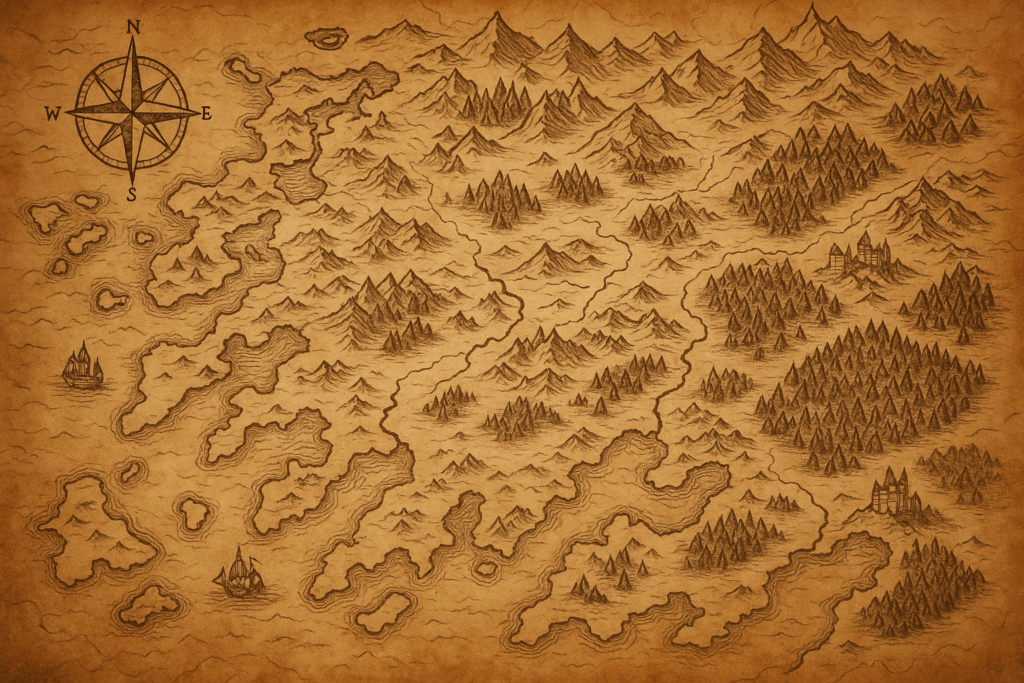
Table of Contents
Creating maps for fantasy worlds is one of the most fun processes you can try in world building. A well-drawn map can spark the imagination, grounding a story or game in a world that feels alive. From the mountain ranges that divide kingdoms to the winding rivers that carve through ancient forests, maps do more than simply show where things are. Maps breathe life into a story world, create an interactive system for Dungeon Masters, and immerse the players of video games. For writers, Dungeon Masters, and world builders of all kinds, learning how to create a fantasy map is one of the most rewarding parts of the creative process. A map is not only something you sketch on a piece of paper, but it’s also an entryway into a universe that you created!
World building in general is probably one of the most rewarding experiences when it comes to designing fantasy and speculative fiction worlds. It’s also something that I’ve learned a lot about over the 10+ years that I’ve been writing, attending seminars, and taking creative writing lessons. For me, world building is part of the journey and it’s part of the reward. That’s why I’m giving away this free 10-question world building primer to help you kickstart the process today. Just sign up below to grab your copy right now.
Check out my books on Amazon as well!
Your World Building Journey Begins Here…
Get 10 powerful prompts that will spark a living, breathing world and set the stage for the epic details to come.
A Messenger Has Arrived…
They carry your 10-Question World Primer, sealed with my crest. Break the seal (open your inbox) to begin shaping your realm.
If you’re also ready to take your world building adventure to the next level, then I recommend you grab my Ultimate Guide to World Building. It’s a 340+ page workbook that is basically like a course and a workbook all in one! It teaches you and gives you a chance to apply what you learn to your own ideas. Be sure to pick up a copy today and get building right away → The Ultimate Guide to World Building.
Why Do Fantasy Maps Matter Anyways?
A fantasy map isn’t just decoration. It helps readers or players picture the scope of your world, understand the journeys your characters undertake, and get a sense of the cultures that live there. Think about iconic maps from novels or roleplaying games: they don’t just show cities and borders, they hint at histories, conflicts, and mysteries waiting to be uncovered.
The simple act of placing a ruin deep in a desert can plant questions in the minds of your audience such as: who built it, and what happened to them?
Maps can even set the tone of your world before a single word of story has been read. A map filled with ominous mountain chains and storm-lashed coasts signals a grim setting, while one dotted with rolling hills and peaceful towns feels lighter and more whimsical.
Maps also help to create a sense of possibility. When players see locations on a map that you haven’t explained, their imaginations fill in the blanks. The players/readers might start speculating, asking questions, and even guessing and creating theories. This sort of curiosity helps to fuel excitement for the story ahead.
Basically, a good fantasy map doesn’t just reveal all the information. It invites exploration as well as creates a sort of visual guide into the world that the reader or player is about to embark on a journey in.
How to Create a Map for a Fantasy World
STEP 1: Start with the Big Picture
When creating your own map, it helps to start broad. Think about the tone of your world. Is it a high fantasy setting with sprawling kingdoms and vast oceans? Or is it more close-up, with just a few villages and a cool forest to explore? The scale of your world will shape the map itself.
Begin with big-picture items like coastlines and continents. Don’t worry about making them perfect. In your first iteration, you’ll probably create some landmarks and sketches that you may not end up keeping.
A good way to think about this step is the following: Imagine you’re holding a bird’s-eye view of your world. Where do the continents lie? Where are the oceans and how do they wrap around the masses of land? This perspective can help to set the stage for everything else in your map.
A massive landmass might imply a world dominated by empires, while a cluster of islands might create a culture of sailors, explorers, and pirates. Think about the goals of your story and then sketch what comes to mind.
STEP 2: Add Natural Features
Once you’ve drawn the outline of your land, begin layering in the natural geography. Mountains, rivers, forests, and lakes all help define how people live and move through the world. Mountains can act as natural borders between nations. Rivers often serve as lifelines for cities and farmland. Forests might be enchanted, feared, or fought over.
Geography is more than just a piece of the scenery as it shapes culture, politics, and pretty much everything else in the world.
You want to think about how the natural features and landmarks will interact. Rivers flow from mountains and into the seas and forests often exist around fertile valleys. Things like this are important to consider, especially when it comes to thinking about the world you’re building and its logical flow.
Adding thoughtful details like this can also help to create material for encounters and adventures in your narrative. Maybe there’s a canyon that your DND players will engage with to face off against an enemy. Maybe your novel is going to feature naval battles and a volcano creates an issue for the sailors.
STEP 3: Place Settlements and Landmarks
After you’ve established the terrain, it’s time to add some evidence of life and civilization. This can be both human and non-human, depending on how extensive your species-building is throughout your story.
Where are the cities, towns, and villages? Think about why they exist where they do. A city might grow along a river for trade, or be located near the edge of a mountain for protection. Don’t just place settlements at random and give them reasons to be there. This not only makes the map more logical, it helps you understand how people live in your world.
Beyond cities, add landmarks that tell stories. Think about what might hint at ancient wars or old religions. For example, maybe a mysterious tower in a swamp suggests that the region holds some dark secrets?
One of my favorite resources that I created to share with you my process in building haunted/cursed regions is this Haunted Region System Builder, which is a workbook that helps break down how to create a haunted region and includes encounter tables to spark some inspiration and ideas for your next world!
STEP 4: Think About History and Culture
A good map doesn’t just show where things are now. It also helps to reflect the past and the remnants that exist today. Think about how in the real world, our maps are constantly shifting throughout history.
For example, maybe a series of wars has resulted in some countries changing their borders. Maybe a ruined city can hint at a once-great empire. Trade routes can tell you who is wealthy in your world and who may be struggling. These little details reflected in your fantasy map hint at a living, breathing world that your readers/players will be able to explore.
Consider the culture of the people living in your world as well. Where do they settle and why? For instance, early civilization points to humans setting up shop near major rivers because of the farming potential there (Mesopotamia, Ancient Egypt, etc…). At the same time though, there have been plenty of nomadic cultures that have existed throughout history, and some cultures that live in harsh desert climates. Think about the significance of these things when creating your map.
STEP 5: Add the Small Details
The magic of a fantasy map often lies in the little touches and details. These details are meant to help make your map feel actually personal and engaging for your readers. Don’t be afraid to add as many as you like, and make them as intriguing as you want. You might be able to branch out into a real mystery in your story with these little details you’re adding at this stage.
If you’re creating a DND world, you might find that your players want to explore those little details or maybe you can use a detail in a novel to create a whole new subplot of exploration.
These details make your map also much more fun to look at. When people notice these elements that you’ve included, they feel more immersed in your ideas.
STEP 6: Make It Functional
Creativity is definitely necessary for fantasy map-creation, but you need to remember that your map is still a tool. For readers, it helps them follow the journey. For players at the table, it serves as a guide to exploration. A cluttered or overly complicated map can be distracting.
Keep things clear enough that anyone looking at it can quickly understand the world’s layout. Some things that might help are to use symbols, shading, or color to distinguish between terrain types, and make sure your settlements are easy to spot.
Ask yourself: would someone unfamiliar with your world be able to use the map to follow the story? If the answer is yes, then you’ve struck the right balance. Functionality doesn’t mean you have to sacrifice style. Instead, it just means that clarity is also important. A map that looks beautiful but confuses its audience isn’t doing its job.
STEP 7: Experiment with Style
Part of the fun of fantasy maps is deciding what they look like. Do you want something that looks hand-sketched and old, with parchment textures and inked coastlines? Or something more polished and digital, with glowing colors and dramatic shading?
Your style can easily help to reflect the personality of the world you’ve designed. For instance, in a grimdark setting, you might find that a map with an old and worn look and dark lines fits the best. Meanwhile, a cozy fantasy world might benefit from a more whimsical map with organic shapes and bright hues.
Should You Use a Digital Tool or Hand-Draw Your Maps?
For the most part, when it comes to creating a fantasy map, you can really choose to use a digital tool or to draw it by hand on a piece of paper. You can even use a digital app like Photoshop or Procreate to draw your map out. What you need to consider though is what you find suits you as a map-designer the best.
Some people find using a software like Inkarnate is the best option while others really like to just sketch freely and then digitize using Adobe Photoshop. I’ve personally experimented with a ton of tools and I can say confidently that there’s no one right answer to this question.
I have a separate blog post about the best fantasy map-making tools if you want to check that out!
Conclusion
Creating a fantasy map is both an artistic and storytelling exercise. You don’t need to be a professional cartographer to make something inspiring. All you need is a willingness to play with shapes, think about how geography influences culture, and let your imagination fill in the rest.
Every mountain, river, and town you place adds another layer of depth to your world, inviting readers or players to step inside and explore. Start broad, add detail, and let your world grow naturally around the map you create.
And remember, maps aren’t always static. If you have a multi-book series or you’re working on a DND campaign, your world will change as the stories unfold. Borders will shift, cities will fall, and new landmarks will rise. Updating your map to reflect these changes keeps it alive, just like the world it represents.
Don’t forget to check out The Ultimate Guide to World Building so that you can start formulating your next world with a launchpad that’s been trusted by tons of writers and world builders just like you! I’m giving you all of my experience in over 340 pages so that your stories can shine amazingly.
Don’t forget to also sign up for my newsletter and grab your free 10-question world building primer so you can get a quick start on the world building process right away. You’ll also get access to exclusive discount codes, freebies, writing and world building insights, and more.
Your World Building Journey Begins Here…
Get 10 powerful prompts that will spark a living, breathing world and set the stage for the epic details to come.
A Messenger Has Arrived…
They carry your 10-Question World Primer, sealed with my crest. Break the seal (open your inbox) to begin shaping your realm.
FAQs
Not at all. Even rough sketches can be enough to guide your story or campaign. The goal is clarity and inspiration, not perfection.
You can use simple pen and paper, digital tools like Photoshop or GIMP, or dedicated map-making software such as Inkarnate. Choose the tool that feels most comfortable for your style.
Follow natural logic. Rivers usually flow from mountains into lakes or seas. Forests grow in fertile regions, while deserts often appear in rain shadows. Thinking about real geography makes your map more believable.
It depends on your needs. If you’re writing a novel, you may only need broad strokes. For a roleplaying campaign, more detail helps players explore. Start broad, then add detail gradually as the story develops.
Not necessarily. Focus on the places important to your story or campaign. Too many details can clutter the map, while selective features spark curiosity and leave room for imagination.
Absolutely. Many fantasy maps borrow from real landscapes and cultures. Studying Earth’s geography can help you design rivers, mountain ranges, and climates that feel authentic.
Add small quirks and imaginative landmarks. A crescent-shaped island, a city carved into cliffs, or a mysterious ruin in the desert makes your world stand out and encourages storytelling.