
How to World Build for a DND Campaign: Step by Step Guide
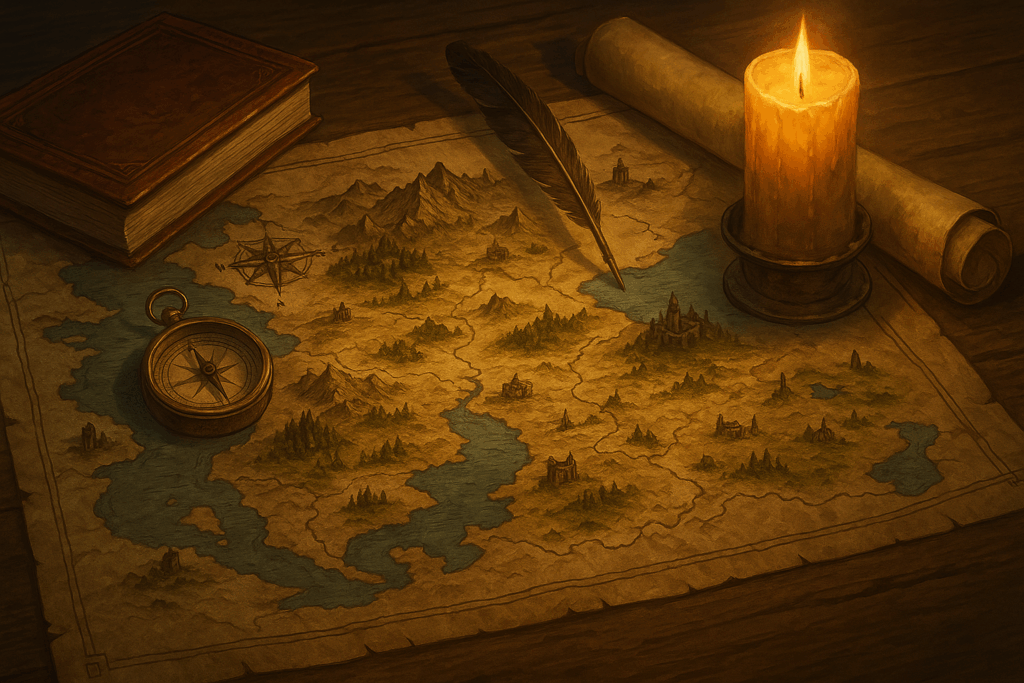
Table of Contents
World building is one of the most rewarding and imaginative parts about creating and running a Dungeons & Dragons (DND) campaign. People who create these campaigns are often called Dungeon Masters or DMs. Dungeon Masters have an opportunity to breathe life into a universe of their own design, complete with its own cultures, landscapes, histories, and mysteries. For players, it provides the foundation that makes their characters’ choices meaningful and their adventures really memorable. By crafting a well-thought out world, it really enhances the quality and the delivery of the campaign for the players. So, in this post, I’ll be talking about what world building is, why it matters in DND, and how to world build for your next DND campaign.
I’m an author who’s been writing for over 10 years (check out my books here) and I naturally got into DND and other similar TTRPGs because of my love for fantasy and world building. I think that there’s a lot of fun to be had with world building and that it really makes the entire experience of a TTRPG better. That’s why I’ve created this free world building 10-question primer to help you kickstart your world building journey the right way. Grab it below and start building your next amazing adventure:
Your World Building Journey Begins Here…
Get 10 powerful prompts that will spark a living, breathing world and set the stage for the epic details to come.
A Messenger Has Arrived…
They carry your 10-Question World Primer, sealed with my crest. Break the seal (open your inbox) to begin shaping your realm.
On another note, I’ve also got this excellent resource for world builders that I definitely think you’ll like. It’s called The Ultimate Guide to World Building and it’s a 340+ page workbook that includes tons of sections that cover everything you need to know about world building. It’s helped out a ton of writers and world builders already with its active-learning methods and its guided question sections. So, be sure to grab your copy today → The Ultimate Guide to World Building.
What is World Building in DND?
In DND, world building is basically the process of creating the setting and fake world that your DND campaign is going to play out in. This includes everything from the geography of continents and the politics of kingdoms to the folklore, religions, and small details that give your world texture.
Some Dungeon Masters like to come up with their own ideas and design their own systems. Others like to use preset worlds and fill in little details as they go. I think it’s a lot of fun to be able to create everything from scratch, and it’s one of the reasons I enjoy world building so much. Basically, your world can be as expansive or as minimalist as you like.
Some Dungeon Masters prepare sprawling maps, multi-generational histories, and libraries of lore before the first session ever begins. Others prefer a more improvisational approach, sketching out the broad strokes and filling in details as the story unfolds.
Both styles are completely valid, and many DMs find themselves somewhere in between. The important thing is that the world feels consistent and immersive. It should be a place where player actions matter and where choices ripple outward into the story.
Why World Building Matters in DND
World building has a major impact in DND and it can really affect the player experience. A well-developed world draws players in and makes them feel like they are part of something larger than themselves. Immersion comes from consistency and that is when the geography, politics, and rules of the world make sense. This consistency allows for the player experience to be elevated and lets them have confidence in their exploration.
Engagement follows naturally after this. When players realize that their choices affect the world, whether by toppling a corrupt ruler, saving a city from destruction, or forging an alliance between rival factions, they feel a sense of ownership.
The freedom to explore and improvise is also crucial. If the world is rich and flexible, players can wander off your carefully laid path and still find adventure without breaking the story. World building is essentially the canvas that makes all of this possible.
How to World Build for a DND Campaign, Step-By-Step
Step 1: Choose Your World’s Tone
The first thing you want to do with your DND world is to decide what your world is supposed to feel like. There are lots of tones that you can pick from and it ultimately depends on what sort of experience you want your players to have.
Here are some common tones that a lot of world builders pick:
- Gritty (think Berserk)
- Whimsical wonder (think Alice in Wonderland)
- High fantasy (think LOTR)
Step 2: Start Large and Zoom In
There are many ways people start world building, but the way I usually teach it is to start broad and then narrow in on the details. Throughout The Ultimate Guide to World Building, you can jump around as you want, but the first section immediately gets into the universe and goes down to the details.
Thinking of the big picture first makes it easier to think about the smaller details when you have a broad canvas. It keeps a point of reference for your world building process.
Step 3: Create a Map
Creating a map is a big part of the DND experience and it’s something that’s a lot of fun for world builders. I personally love to just sketch out maps of different cities, countries, continents, etc… There’s a lot of ways that you can do this, like use a program or use a piece of paper and just sketch things out however you want.
I have a free Hex Crawl starter sheet that includes some hexagon-grid paper that you can grab and sketch out some encounter maps with. You can also check out this post I wrote about the best programs to create a fantasy map with.
Step 4: Come Up With Some Story Hooks
The next thing you want to do is to create story hooks that are relational to the map you just created. You should place memorable landmarks that invite questions. This could be a haunted forest, a crumbling bridge, or a city that’s overlooked by a giant statue of an ancient deity.
One thing you can do to help you work through some of these regions is my haunted region system builder, which is a workbook that includes encounter sheets, prompting questions, and tons of opportunities for you to create a cool spooky region.
Step 5: Create Your NPCs
NPCs are like characters in a standard novel and they impact the way the player interacts with the world. Think of a video game when you’re walking around and start a random dialogue with someone.
Before you create those NPCs, you need to think about the main cultures, the governments, the languages, the religions, etc… Your NPC behavior will be impacted by these sorts of determining factors.
The people playing in your campaign will also want to feel that the world is lived-in and feels like a real world they could go to. That’s why focusing on the NPCs is a big part of the process.
You can check out my fillable character worksheet to help create your NPCs!
Step 6: Define the Factions and Conflicts
The next step is to think about the groups: Guilds, orders, cults, criminal syndicates, religious orders, etc… These groups also impact the overall way the world is designed and how the players will interact with your campaign and NPCs.
Creating conflict between the factions is also a great way to add more depth to your world and to make it feel like it’s active and constantly changing. That way, your players will feel engaged and encouraged to enjoy the campaign.
One game I feel did this part really well has to be The Elder Scrolls IV: Oblivion. It’s one of my favorite games and I love trying for all the guilds and groups in it! If you’ve never played it before, you need to try it out!
Step 7: Create the Lore
The next thing you want to do is to try and create a bit of lore about the past. This doesn’t need to be super extensive. Include around three to six events that still matter in the present day. You’ll have to pick and choose the most important ones like wars, alliances, natural disasters, legends, etc…
The lore, however, needs to actually play some form of a role in the current campaign. For example, it might be that some ancient war led to the burial of an important magical item that your players will need to search for in the current day.
If you want to learn how to create some fun magical items, then check out my Magical Item Workbook!
Step 8: Create a Starting Area
The next thing you want to do is to create a starting area. This is the first town or district the party interacting with your campaign will visit. This place is going to be one of the most important to flesh out. You want to think of street names, notable NPCs, local quests, and locations within this area that players can explore.
Step 9: Iterate After Every Session
Make sure that you’re keeping a change log of all the consequences. When something significant happens with your players, you want to make sure that you’re updating your world notes and keep track of it. For example, when players topple a tyrant, update the political structure of your world. If a particular faction is favored over another, you want to show who gains and loses. If your world is reacting to changes, it’ll feel immersive and alive.
Tips for Building a Playable World for DND
When world building, focus your energy on the places and details that will actually affect your players. A single well-developed city, with its politics, marketplaces, and characters, can provide endless adventure. It’s far more effective than scattering your attention across an unfinished continent.
Themes can also keep your world coherent. If magic is rare, dangerous, or forbidden, let that influence how societies behave. If survival is the central theme, design environments and conflicts that constantly test the party’s endurance.
Don’t hesitate to borrow ideas from history, mythology, or your favorite novels and shows. Inspiration is everywhere, and adapting these ideas into something new saves time while creating resonance for your players. Just remember to stay consistent with the rules you set.
If, for instance, you decide that magic drains life force, make sure that applies everywhere, not just when it’s convenient for the plot. And avoid overwhelming your players with lore. Let them discover the world gradually through exploration and interaction, not through lectures.
This sort of consistency is something that I make sure to hone in on a lot in The Ultimate Guide to World Building, and I think that it’s something that you can definitely benefit from as well if you’re world building for a DND campaign!
Mistakes to Watch Out For in DND World Building
One common mistake some DMs make is overloading your players with information at the start. A twenty-minute history lesson in session one is more likely to bore than inspire. Players want to learn about the world through action.
Another mistake is ignoring player choices. If the party defeats a tyrant, the political landscape should change. If they ally with one faction, another might resent them. The world should feel reactive, not static.
At the same time, don’t forget the power of small details. A unique NPC or a striking landmark can do more for immersion than entire chapters of lore.
Also, you want to avoid static rigidity. If the players decide to explore a forest you didn’t prepare, be ready to improvise. Flexibility keeps the world alive. That’s also part of the magic of being a DM!
World Building for DND vs. World Building for Novels
Although the fundamentals of world building apply across mediums, creating a DND world has some marked differences when compared to world building for a novel.
In a novel, the author controls every twist and outcome. Everything is fully up to the design of the writer and the reader is simply following along the author’s lead. They are not actively forcing change on the world.
In DND on the other hand, the players can derail or reshape the story with their own choices. The world has to be ready at a moment’s notice to basically accommodate that. DND is based on interactive consumption, but novels are more passive.
The level of detail that a novelist can pack into a single chapter is much different from the way a DND Dungeon Master packs detail. A novelist can spend basically several pages describing one city in the story. However, a DM has to provide enough description to spark imagination but give room for the players to imagine.
Novels also tend to be solo projects but DND is a collaborative experience. The Dungeon Master’s job is to build the framework, establish the logic, and set the rules. However, the players’ and their stories impact the progression of the story, and thus the world.
For example, in a novel, the author decides who betrays whom and when. In a DND campaign, the players might befriend the queen, assassinate the king, or stage a rebellion, forcing the DM to adapt.
Expanding Your World Beyond the Table
Many Dungeon Masters find that their worlds are so expansive, it grows beyond the game sessions. I know that a lot of DMs out there like to write lore documents or wikis, which lets players revisit details between the games. Some like to commission artists to illustrate important elements of their worlds. A lot of other DMs actually take their DND world and turn it into a novel. For example, Malazan Book of the Fallen was a DND campaign before it became a series!
A lot of people like to use tools like World Anvil to create a published, public wiki that includes all the necessary information about their world building to help orient their players. You can check out my review on World Anvil here to learn more!
Conclusion
World building for Dungeons & Dragons is equal parts art, improvisation, and collaboration. It deepens campaigns, enriches characters, and makes game nights much more memorable.
Whether you’re drawing maps, inventing legends, or creating NPCs on the fly, your goal is to make your players feel like the world is alive. Start broad, add detail where it matters most, and let the setting grow organically with your campaign.
You want your players to feel like they belong within the world of your campaign and not just like they are semi-interacting with it. Part of the reason why people love RPGs and TTRPGs so much is because of the immersion, interactivity, and customization. You feel like you genuinely can exist in another world!
So, don’t forget to check out The Ultimate Guide to World Building, which is a great resource no matter what project you’re working on. With over 340 pages of content and organized systems, you’ll be getting access to the biggest world building interactive workbook out there!
Don’t forget to also grab your copy of my free 10-question world building primer to get a kickstart on the journey right away!
Your World Building Journey Begins Here…
Get 10 powerful prompts that will spark a living, breathing world and set the stage for the epic details to come.
A Messenger Has Arrived…
They carry your 10-Question World Primer, sealed with my crest. Break the seal (open your inbox) to begin shaping your realm.
FAQs
No, you don’t. Many Dungeon Masters start with one town or region and expand as the story grows. The important thing is consistency, not completeness.
It depends on your group. Some players love deep lore, others prefer action. Focus on the areas your party will interact with and add detail gradually as needed.
Improvise. Use broad notes, random tables, or adapt unused ideas on the fly. Players often enjoy shaping the world with you, so ask them questions and build collaboratively.
Absolutely. Many great settings borrow heavily from real-world cultures, myths, and events. Just adapt them so they fit the tone of your world and keep things respectful.
Keep a campaign journal, spreadsheet, or even a wiki where you note down changes and important details. This helps maintain continuity and avoids contradictions later.
Published settings give you ready-made lore and maps, saving prep time, but may feel restrictive. Homebrew worlds let you tailor everything to your group, but require more effort to create.
The Ultimate Guide to World Building is the resource I recommend!